
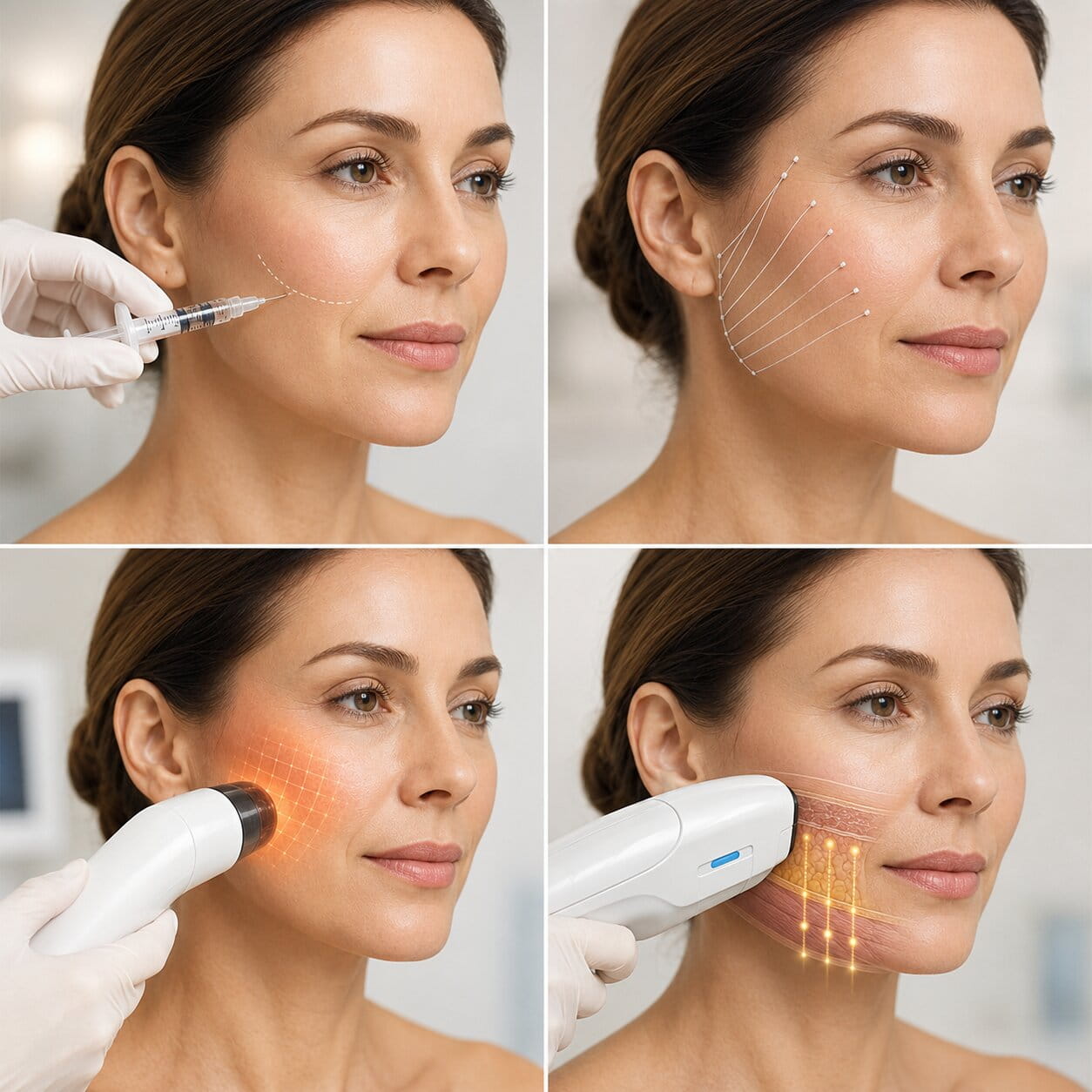
Non-Surgical Face Lift: Comparing Fillers, Thread Lifts, RF, and HIFU
Sagging skin, facial volume loss, the development of deep lines, and reduced definition along the jawline are natural changes associated with aging. In the past, facelift surgery was considered the primary option for correcting these concerns. Today, however, a wide range of minimally invasive and non-surgical facial rejuvenation treatments can improve skin appearance and facial contours without extensive incisions or a prolonged recovery period.
Dermal fillers, thread lifts, radiofrequency treatments (RF), and HIFU are among the most widely recognized non-surgical facelift options. However, these treatments do not work in the same way. Fillers are mainly used to restore lost volume and enhance facial contours. Thread lifts can mechanically reposition sagging tissues, while RF and HIFU deliver energy to specific layers of the skin to stimulate collagen production.
Therefore, choosing the best non-surgical facelift treatment should be based on the main cause of facial changes, the degree of sagging, skin quality, age, facial structure, and the individual’s expectations. In this article, we compare fillers, thread lifts, RF, and HIFU in terms of how they work, their effectiveness, recovery time, longevity, and the concerns they are best suited to address.
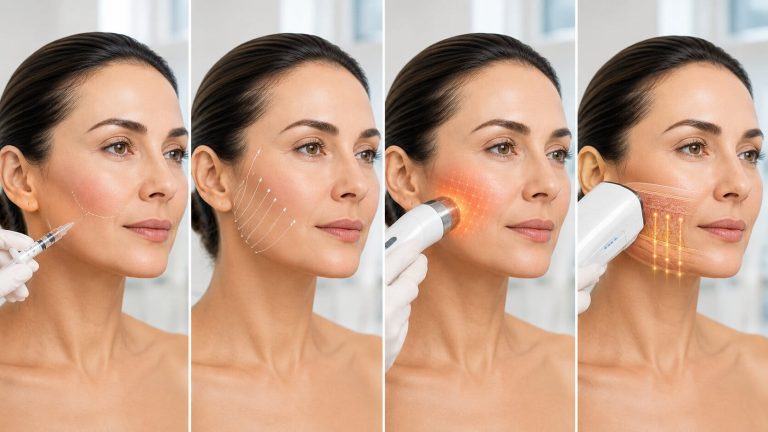
💎What Is a Non-Surgical Facelift?
A non-surgical facelift refers to a group of aesthetic treatments designed to improve skin laxity, facial lines, skin quality, or tissue volume loss without traditional surgery, general anesthesia, or large incisions.
The term “non-surgical facelift” does not mean that every treatment is completely non-invasive. For example, HIFU and some types of RF are performed without inserting instruments into the skin. In contrast, dermal fillers and thread lifts are considered minimally invasive because they involve the insertion of a needle, cannula, or thread into the tissue.
The goals of these treatments may include:
Reducing mild to moderate skin sagging
Improving jawline definition
Enhancing the shape of the cheeks and chin
Softening deep facial lines
Restoring age-related volume loss
Stimulating collagen and elastin production
Improving skin firmness and quality
Creating a more youthful appearance without dramatically altering facial features
It is important to understand that no non-surgical treatment can produce the same results as facelift surgery in cases of severe skin laxity. These treatments are generally more suitable for people with mild to moderate sagging, those seeking a more natural-looking result, or individuals who prefer to avoid the recovery period associated with surgery.
💎Why Does Facial Skin Sag with Age?
Facial sagging is not caused only by loosening of the skin’s surface. Aging affects several different layers of the face. Reduced collagen and elastin production leads to a loss of skin firmness. At the same time, volume decreases in certain areas, facial fat pads may shift, and changes in the underlying bone structure can reduce support for the soft tissues.
As a result, the following changes may occur:
Reduced cheek projection
Deeper nasolabial folds
The development of lines around the corners of the mouth
Sagging in the lower face
Loss of jawline definition
The appearance of a double chin or loose skin beneath the chin
Hollowing of the temples or under-eye area
Reduced skin quality and firmness
This is why a single treatment is not suitable for everyone. A person whose main concern is cheek volume loss may achieve better results with dermal fillers. However, someone with adequate facial volume who is mainly affected by skin laxity may be a more suitable candidate for RF or HIFU.
🔹Facelift with Dermal Fillers
A dermal filler is an injectable substance used to restore volume, soften facial lines, enhance contours, and provide structural support in different areas of the face. Many commonly used fillers are made from hyaluronic acid, a substance that is also naturally found in the body.
Fillers do not actually tighten or shrink the skin. Instead, by restoring lost volume and creating support in specific areas, they can reduce the appearance of sagging. This is why terms such as “facelift with fillers” or “liquid facelift” are sometimes used.
Which Areas Can Be Treated with Fillers?
Depending on the physician’s assessment, fillers may be used in the following areas:
Cheeks and the midface
Chin
Jawline
Temples
Lines around the mouth
Certain under-eye hollows
Areas affected by volume loss
Precise injections in the cheeks, chin, or jawline can improve facial proportions and indirectly reduce the appearance of sagging in the lower face.
Benefits of Dermal Fillers
A large part of the result can be seen quickly
Precise contouring of different facial areas
Suitable for restoring facial volume loss
Relatively short recovery time
The amount injected can be adjusted according to facial structure
Some hyaluronic acid fillers can be dissolved when necessary
Suitable for contouring the cheeks, chin, and jawline
Limitations of Dermal Fillers
Dermal fillers are not suitable for severe skin laxity. Overfilling can also make the face appear heavier, puffy, or unnatural. The goal of treatment should not be limited to filling individual lines. The overall facial structure, areas of volume loss, and the proportions between different facial features should also be carefully evaluated.
Swelling, redness, tenderness, and bruising are common and usually temporary side effects of filler injections. The most important serious but rare complication is accidental injection into a blood vessel, which may lead to tissue damage and, in extremely rare cases, visual impairment. For this reason, dermal fillers should be administered by a properly trained physician with a detailed understanding of facial vascular anatomy.
🔹Who Is a Better Candidate for Dermal Fillers?
Dermal fillers are generally more suitable for individuals who:
Have noticeable volume loss in the cheeks or temples
Need enhancement or contouring of the chin or jawline
Have facial sagging that is partly related to reduced structural support
Are looking for relatively fast results
Do not have significant excess or severely loose skin
Have realistic expectations about non-surgical treatment outcomes
🔹Thread Lift for the Face
During a thread lift, specially designed threads—typically absorbable ones—are inserted into the tissue beneath the skin through small entry points. Some threads have barbs or other structural features that attach to the tissue and allow limited repositioning.
A thread lift can work in two ways: first, by mechanically repositioning the tissue, and second, by stimulating a healing response and collagen production around the threads. The American Society of Plastic Surgeons describes a thread lift as a minimally invasive procedure in which absorbable, barbed threads are used to create a firmer and more youthful appearance in the face and neck.
🔹Which Areas Can Be Treated with a Thread Lift?
A thread lift may be considered for the following areas:
Mild sagging of the cheeks
The lower face
The area around the jawline
The eyebrows
The neck
Downturned lines at the corners of the mouth
The degree of lifting achieved depends on the type of thread, the direction of placement, skin quality, tissue thickness, and the physician’s skill and experience.
🔹Benefits of a Thread Lift
Provides a degree of immediate mechanical lifting after treatment
Stimulates collagen production around the threads
Requires less recovery time than surgery
Does not involve large incisions
Suitable for certain cases of mild to moderate sagging
Can be used in a targeted way to treat specific areas
🔹Who Is a Better Candidate for a Thread Lift?
A thread lift may be suitable for individuals who:
Have mild to moderate sagging in the cheeks or jawline
Want a more noticeable lifting effect than energy-based treatments may provide
Prefer to avoid surgery
Have skin with enough strength and quality to support the threads
Do not expect dramatic or permanent results
Are willing to follow the required recovery restrictions and aftercare instructions
🔹Facelift with RF (Radiofrequency)
Radiofrequency, or RF, is a treatment that uses radiofrequency energy to generate controlled heat within the tissue. This heat may cause partial contraction of existing collagen fibers and stimulate collagen remodeling over the following months.
There are different types of RF treatments. Some devices work without inserting needles into the skin and are completely non-invasive. Another type, known as RF microneedling, uses fine needles to deliver energy to a specific depth within the skin and is considered minimally invasive.
Scientific studies and reviews have associated RF treatments with improvements in skin firmness, texture, and overall tightness. However, the outcome depends on the type of device, energy settings, number of sessions, treatment area, and the individual characteristics of the patient.
🔹What Concerns Does RF Primarily Target?
The less direct contact there is with the follicles, the lower the risk of mechanical damage.
For this reason, using specialized instruments and following proper graft-handling techniques are important factors in preserving follicle quality.
Benefits of RF
Gradually stimulates collagen production
Helps improve skin quality and firmness
Can be used on the face, neck, and certain areas of the body
Involves minimal recovery time with non-invasive RF treatments
Produces gradual and natural-looking results
Allows treatment settings to be adjusted based on the target depth and type of device
Limitations of RF
RF results are usually neither immediate nor dramatic. It often takes several weeks to a few months for the final outcome to become noticeable. Some devices may also require more than one treatment session.
With non-invasive RF, temporary redness, warmth, and mild swelling may occur. RF microneedling may cause more noticeable redness, swelling, peeling, or inflammation. Incorrect energy settings or inappropriate treatment depth can increase the risk of burns, pigmentation changes, scarring, nerve injury, or unintended loss of subcutaneous fat. For this reason, RF microneedling should be regarded as a medical procedure and performed by a properly trained professional.
🔹Who Is a Better Candidate for RF Treatment?
RF may be a suitable option if:
The main concern is reduced skin quality and firmness
Skin laxity is mild to moderate
The individual prefers gradual and natural-looking results
There is no significant loss of facial volume
The individual does not want dermal fillers or thread placement
Improving skin texture is desired in addition to a mild lifting effect
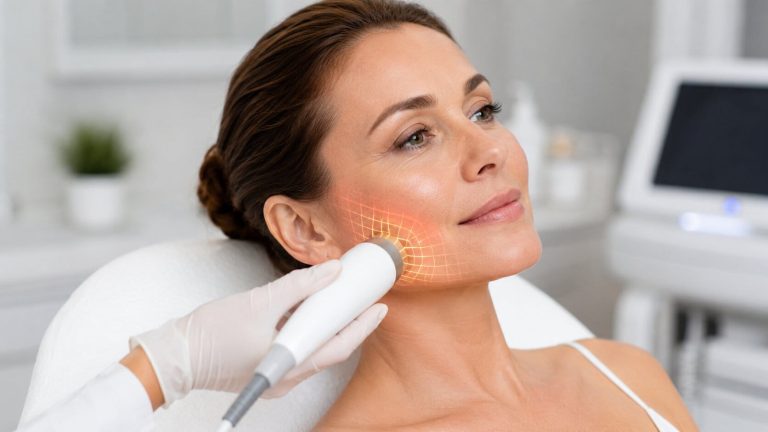
🔹Facelift with HIFU (High-Intensity Focused Ultrasound)
HIFU, or High-Intensity Focused Ultrasound, uses focused ultrasound waves to deliver energy to specific depths within the tissue. This energy reaches the targeted areas without surgical incisions and creates controlled heat that stimulates collagen remodeling and production.
In standard devices, different cartridges or settings can deliver energy to varying depths of the skin. The goal of treatment is to improve skin firmness and reduce mild to moderate laxity, rather than produce an immediate and dramatic change comparable to surgery.
Scientific reviews have shown that focused ultrasound may be effective for tightening facial skin with mild to moderate laxity. However, individual responses vary, and more high-quality studies are still needed to determine the most effective treatment protocols.
💎Which Areas Can Be Treated with HIFU?
HIFU may be used for the following areas:
Jawline
Under the chin
Neck
Cheeks
Around the eyebrows
Certain fine lines and areas of mild facial sagging
Benefits of HIFU
Does not require injections or surgical incisions
Involves minimal downtime
Gradually stimulates collagen production
Suitable for mild skin tightening
Can be used on the jawline, under the chin, and neck
Produces results that develop gradually and appear natural
💎Limitations of HIFU Treatment
HIFU is not designed to restore facial volume, fill hollow areas, or directly correct deep lines. Individuals with a thin face or significant facial fat loss should be evaluated more carefully, as choosing the wrong device, treatment depth, or energy level may create an unbalanced facial appearance.
During treatment, patients may experience pain, tingling, or a sensation of heat. Temporary redness, swelling, tenderness, and numbness may also occur. Serious complications, such as burns or nerve injury, are rare, but they highlight the importance of using a reliable device and choosing a properly trained practitioner.
💎Who Is a Better Candidate for HIFU Treatment?
HIFU may be suitable for individuals who:
Have mild to moderate skin laxity
Prefer a completely non-invasive treatment
Do not want injections or thread placement
Are willing to wait for the results to develop gradually
Have adequate facial volume and are mainly concerned about loose skin
Do not expect results comparable to surgical lifting
💎Who Is a Good Candidate for a Non-Surgical Facelift?
A suitable candidate is generally someone who:
Has mild to moderate skin laxity
Expects natural results that are more limited than those of surgery
Is in good overall health
Has no active skin disease or infection in the treatment area
Is honest with the physician about medications, medical conditions, and previous treatments
Is willing to follow pre- and post-treatment care instructions
Understands that the results of non-surgical treatments are not permanent
💎Who May Need a Surgical Facelift?
Non-surgical treatments may produce only limited improvement in the following situations:
Significant excess skin and severe sagging
Prominent neck bands and marked neck laxity
Noticeable sagging of the lower face
A desire for a dramatic and long-lasting change
The need to remove excess skin
Tissue structure that is not suitable for threads or energy-based devices
In these cases, consultation with a plastic surgeon can help the patient make a realistic comparison between surgical and non-surgical treatment options.
💎General Aftercare Following a Non-Surgical Facelift
Aftercare instructions vary depending on the treatment performed, but the following recommendations are generally important:
Avoid touching, pressing, or massaging the treated area unless instructed by your physician.
Avoid strenuous exercise, saunas, and excessive heat for the recommended period.
Do not use skin-irritating products unless approved by your physician.
If medication or a topical cream is prescribed, use it exactly as directed.
Protect your skin from sun exposure.
Attend scheduled follow-up appointments to assess the results and identify any possible complications.
Contact your physician immediately if you experience severe pain, unusual skin discoloration, vision changes, muscle weakness, increasing swelling, or signs of infection.
💎How Is the Best Non-Surgical Facelift Method Chosen?
- The degree and location of facial volume loss
- The severity of skin laxity
- Skin thickness and quality
- The amount of subcutaneous fat
- Facial bone structure
- Facial symmetry
- Previous treatments and injections
- Medical conditions and current medications
- The patient’s expectations
- Willingness to accept recovery time
- Budget and the possibility of repeat treatments
- The degree and location of facial volume loss
- The severity of skin laxity
- Skin thickness and quality
- The amount of subcutaneous fat
- Facial bone structure
- Facial symmetry
- Previous treatments and injections
- Medical conditions and current medications
- The patient’s expectations
- Willingness to accept the required recovery time
- Budget and the possibility of repeat treatments

Get a free consultation or book an appointment.
For a free consultation and appointment booking, please complete the form below, our experts will contact you as soon as possible.
🌟Final Summary
Fillers, thread lifts, RF, and HIFU each contribute to facial rejuvenation in a different way. Dermal fillers are mainly used to restore lost volume and improve facial contours. Thread lifts can mechanically reposition tissue in certain cases of mild to moderate sagging. RF focuses on stimulating collagen production and improving skin firmness and texture, while HIFU delivers focused ultrasound energy to specific tissue depths to support gradual skin tightening.
None of these treatments can be considered the best option for everyone. The most appropriate non-surgical facelift method is the one selected according to the underlying cause of facial changes and capable of producing a natural, balanced, and safe result with the least necessary intervention.
A thorough medical evaluation is essential before making a decision. The type of device, the quality of injectable materials, the physician’s skill, proper sterile technique, and appropriate follow-up care all play important roles in both the safety and the final outcome of treatment.
Frequently Asked Questions (FAQs)
❓1.Which Non-Surgical Facelift Method Provides Faster Results?
Dermal fillers generally provide faster results in terms of facial shape and volume. With a thread lift, some tissue repositioning may also be visible immediately. RF and HIFU results usually appear more gradually because they depend on collagen remodeling.
❓2. Is Dermal Filler or HIFU Better for Jawline Contouring?
If the jawline lacks definition because of insufficient volume or an underdeveloped chin or jaw shape, dermal filler may be the more suitable option. If the main concern is loose skin under the chin and around the jawline, HIFU or RF may be considered. In some cases, a combination of treatments may be required.
❓3. Is a Thread Lift Better Than HIFU?
A thread lift can provide a degree of mechanical tissue repositioning, whereas HIFU is a non-invasive treatment with results that develop gradually. The choice between them depends on the severity of skin laxity, skin quality, tissue thickness, and the patient’s expectations.
❓4. Can RF Cause Facial Fat Loss?
RF, when used with appropriate settings, can help improve skin firmness. However, incorrect energy levels or treatment depths—particularly with some more invasive RF devices—may lead to unwanted facial fat loss. Treatment parameters should therefore be adjusted according to tissue thickness and the individual structure of the face.